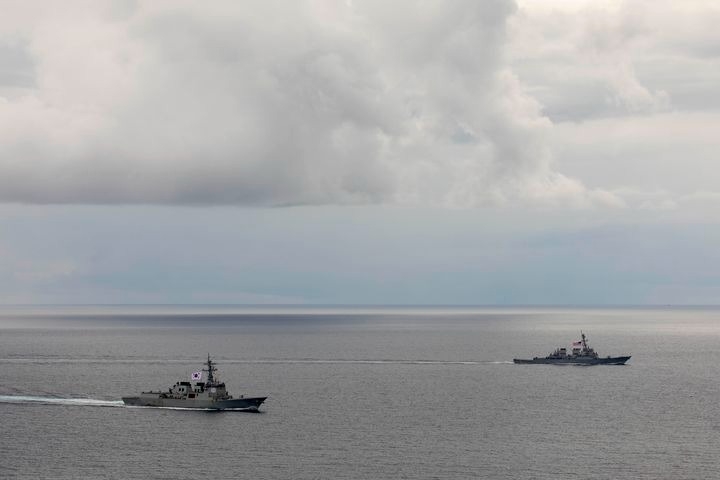
South Korea, the United States and Japan began a five-day joint military exercise Monday, proceeding on schedule even as key Seoul-Washington drills were recently scaled back upon US President Donald Trump's order.
The multidomain Freedom Edge exercise kicked off in international waters east and south of South Korea's southern island of Jeju, South Korea's Joint Chiefs of Staff said in a press release.
"The three nations will leverage the drills to enhance operational capabilities and joint response capabilities across multiple domains, including maritime, air and cyber, while maintaining a robust and stable cooperative relationship," the JCS said.
The drills will involve major maritime and air assets from armed forces of the three countries, with a joint exercise control group overseeing the operations for their systematic and safe execution, the Korean military said.
The JCS stressed the exercise is an annual drill of a defensive nature, conducted in accordance with international law and norms.
"It is aimed at enhancing deterrence and response capabilities against North Korean nuclear and missile threats, while safeguarding regional peace and stability," it added.
This year's Freedom Edge, its fourth iteration since the inaugural launch in June 2024, is being held to its schedule despite the scaling back last month of the bilateral Ulchi Freedom Shield exercise between South Korea and the US
The UFS was scaled back by half after Trump ordered to reduce the drills, in an apparent conciliatory gesture toward North Korea. Pyongyang has long denounced the allies' drills as war rehearsals.
In Monday's readout, the JCS did not elaborate on what military assets will participate in Freedom Edge, although a JCS official said earlier the exercise will be on par with previous years in scope and scale.
The three countries will deploy six Aegis-equipped destroyers, along with maritime patrol aircraft, fighter jets and refueling tanker aircraft, sources familiar with the matter said.
The South Korean Navy is deploying the 7,600-ton ROKS Yulgok Yi I and ROKS Seoae Ryu Seong-ryong destroyers, according to the sources.
Japan's Joint Staff of the Self-Defense Forces said last month it will deploy the 7,700-ton Atago and 5,100-ton Asahi destroyers, the P-1 maritime patrol aircraft, the SH-60K helicopters and F-15 fighter jets.
The US Navy's 7th Fleet revealed on social media last week the arrival of its 6,900-ton Arleigh Burke-class USS Benfold at a port in South Korea's southern city of Busan, in a possible sign that it is joining the trilateral drills.
Last year's drills were held without a US aircraft carrier, its first absence since the inaugural drills, as US carrier strike groups were deployed to the Middle East.
No US aircraft carrier is expected to participate in this week's Freedom Edge, given the ongoing US war against Iran, according to sources.
Announcing plans for the 2026 Freedom Edge in late August, the US Pacific Command said the exercise will feature enhanced real-time data sharing and synchronized coordination among the three countries, with enhanced air defense scenarios and maritime interdiction operations.
The second and third Freedom Edge were held in November of 2024 and in September last year. (Yonhap)